|
| The other Star Warrior on Empire: talented screenwriter and later film director, Lawrence Kasdan. |
The script writing hole left by the passing of Leigh Brackett for
The Empire Strikes Back finally looks set to be filled by an all-new talent. Ex-advertising copywriter turned screenplay writer
Lawrence Kasdan, recommended to George Lucas by his friend Steven Spielberg (the latter having read the writer’s
Continental Divide screenplay), completes his script for the adventure story involving the Lucas created character Indiana Jones (called
Raiders of the Lost Ark - a 1930’s period adventure, the first in a series that Lucas plans to make alongside the
Star Wars films). With deadlines looming, Kurtz and Lucas now desperately need someone to write the
Empire screenplay-someone who can very quickly step in to the process, and who was a good writer. Since George had written the original sequel story anyway, and he was already working with Kasdan on
Raiders (the screenwriter having started work on it at the same time Brackett was writing the first draft of
Empire)-it is decided that it would be easiest for them to use him on the first
Star Wars sequel as well.
 |
| The Sequel 'Dream Team' at Elstree, circa April 1979. |
Though his background with the science fiction/ fantasy genre is not great, Kasdan’s love and familiarity with the
Star Wars source material is, as he recalled: “It (the original film) was jaunty, wise-ass, fast, very modern-sort of a teenaged thing, a polished chrome kind of feel”), and he and Lucas get on extremely well together. Having traveled to San Anselmo to deliver his
Raiders script, Kasdan is taken out to lunch by Lucas, who explains the problems of the
Empire script with the death of Brackett, and the fact that time is running out before pre-production on the film has to begin. He offers Kasdan the job of handling the
Empire script, his stipulation being that he share the screenplay credit for the film with Leigh Brackett so that her estate will benefit from any profits that the film hopefully makes (Lucas does not intend to take any story credit himself (though the film is eventually credits him as 'Story by')). Lucas also tells Kasdan that he can’t pay him much money as an 'up front' fee for the screenplay but guarantees him profit participation from the film’s release.
Amazed to be given the
Empire offer, Kasdan delicately suggests to Lucas that he might actually want to read the
Raiders screenplay first before making a decision about hiring him for
Empire (Kasdan is also worried that he may have to work on two projects simultaneously-fortunately, Spielberg, prior to
Raiders, directs his epic World War II comedy
1941 first, and that it will be at least two years before he can handle the first adventure for Indiana Jones). With a laugh, Lucas tells Kasdan that he will cancel the offer that night if the
Raiders script stinks, but he is in no doubt that he is the right man for the job.
Before beginning work on
Empire, Kasdan goes on vacation, then comes back to work on the script. George hands Kasdan “a very rough draft, somewhere between an outline and a first draft. The structure of the story was all there-it was the skeleton for the movie. What was needed was flesh and muscle” (of which Gary Kurtz recalled to CINEFANTASTIQUE Vol. 28, No. 8 (February 1997): "Leigh had just barely finished her first draft (when she died), up to the two last pages. The pages weren't even typed, but they were done.") Kasdan additionally recalls to STARLOG in 1981: "I only skimmed it (Leigh Brackett's first draft). It was sort of old fashioned and didn't relate to
Star Wars. The characters all had the right names, but her story's spirit was different. I'm sure that had Leigh lived, she could have made the changes that George wanted in an excellent way." In a later interview, Kasdan would state that nothing from Leigh Brackett’s draft would end up in the final version of the film, with Lucas telling him: “God bless her, but she wasn’t doing anything like I wanted it.”
 |
| Kasdan's various script notes and changes/deletions on selected scenes. |
In the first screenplay meetings, Lucas knows exactly what he wants to see in the script (with Kasdan noticing that he has the ideas for the entire saga already mapped out in his head, and which way things were going for the characters) but is widely open to any new interpretations, dialogue and character embellishments, with a lot of room for invention. In one meeting, on August 17th, 1978, Lucas wants Kasdan to inject the film with stronger characterization of the main leads- that they must have a much more complex psychology than they had in the first film.
 |
| Things will soon get a little warmer for Han and Leia after their time on the ice planet of Hoth. |
Between August and September 1978, script conferencing gathers pace with Kershner, Lucas, Kurtz and Kasdan at first meeting every two weeks - eventually settling down to a once a week meeting. They'd go over Lucas’s draft and talk about what they want to be in the movie. Kershner thinks about character, George of the actual story, and Kasdan about the dialogue, which ties in with story and character. The group would take the script, page by page and go over every line, every word. Between meetings, Kasdan would make corrections/additions and add new material to the pages as he could. These new pages would then be discussed in the next meeting and so on and so on until the film was shaped in their eyes. Kasdan discovers that George never tells him when he likes something (though it’s tough on him when presenting material for approval, Kasdan appreciates Lucas not doing this from a practical point of view). In those early beginnings, Kasdan would write a fifth of the movie, get back together with Lucas and Kershner (with Kurtz also) and talk about what was written. A draft was finally reached that represented the movie that will be shot, although a few more drafts would be done to iron out detail changes, with Kasdan particularly liking the fact that the sequel starts off with a massive battle that the Rebels lose-a direct contrast to the happy, medal winning spirit of the previous film’s finale-leading to a very strong character based storyline which darkens in a terrifying finale battle between Luke and Vader. It is in those conferences with Kasdan that George reveals that Darth Vader is Luke’s father, and is very excited by this revelation, knowing that the sequence will have to be very carefully structured and written dialogue-wise. The screenwriter also fleshes out the important love triangle between Han, Luke and Leia present in the story.
 |
| Old friends in new situations. |
Recalled Kasdan to FANTASTIC FILMS magazine: “The first session after we met was the hardest, the first session that I was presenting the pages I had written-the first fifth of the script-a great deal of the emotional basis for the film takes place in that fifth. There are three or four important scenes where the characters are all together. You have to establish the dynamics of the romance that follows and the drama that follows. In fact, you’re not going to have many opportunities later in the film to bring the people together again and have them talk. So you have to figure out how these people feel about each other now on the planet Hoth; what is implied about what happened since we last saw them at the awards ceremony.
"We don’t know what the relationship is between Leia, Han and Luke. Threepio and R2, where did they come down as far as who is their master? They started out one way and ended up another. All these things have to be established immediately. What are Chewie’s feelings about where they are, and is he still impatient to get on about his business or is he devoted to the Rebel Alliance. Han certainly, all his allegiances, what’s he up to now? What does he want to do? Luke broke off his training to be a Jedi Knight when Ben was lost. The question is how important is that to Luke? All of these forces are happening to the characters the second the movie opens. You have to figure out how you are able to communicate what progress has happened between the two movies and how are you going to set up for
Empire the kind of dynamics to make the story which we knew was coming, make sense.
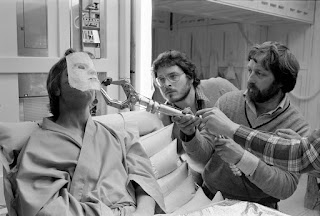 |
| Newly arrived in London with George Lucas to see some early Spring filming of Empire, Kasdan watches an ultimately deleted scene moment with the injured Luke. British special effects technician Ron Hone holds the medical droid prop arm. |
"So, in the first 25 pages, there are several confrontations. It was a very rough task. This was my first time writing the
Star Wars language and creating long talking scenes. Emotional scenes. Kershner and I had different ideas about the way each of these scenes would go. That first session was a ragged, rugged, many, many hours of figuring out what was the best way to set up the story and communicate what’s happened just prior to the story.”
 |
| Chewbacca would receive some additional character depth, not all of which made it to the final screenplay. |
Lucas, anxious that Kasdan capture the tone of
Star Wars from the beginning, is soon pleased at how quickly he catches on to it; in particular how the characters speak in contrast to the real world dialogue of normal movies, of which certain kinds of words and expressions cannot be used in the film, no references to time, and no earthly kind of remarks, such as referring to someone as “lazy as a sloth.” Kasdan is also asked to develop the screenplay based on his own perceptions of the characters in
Star Wars, and what George wanted them to do in the sequel. Marcia Lucas also brings input to the development of the screenplay and Kasdan agrees with a lot of her choices, especially that the film should have more character and story complexity, whist George, whose natural film editing skills/ instincts are an added bonus to its creation, thinks the narrative should be simple in another way, requesting speed and clarity.
Some ideas/concepts are sadly lost in the final structuring. Recalled Kasdan to
The Empire Strikes Back Notebook: “One story idea I wanted to develop was Chewie’s jealousy of Han and Leia’s relationship. Though that was lost in the final script, I thought it was an interesting idea. Chewie is the classic sidekick, a loyal buddy. But he is also a character who has real feelings. It is suggested in the film, but not as strongly as I had in mind.” Additionally, Kasdan feels that C-3PO, in his version of the script, would end up being pretty superfluous-with Kershner deciding that the droids involvement in the sequel will be sorted out at some point in the filming.
 |
| The charm and mystery of Yoda. |
The creation of several new characters into the saga also introduces new challenges and problems to be overcome. Kasdan recalls that “creating Yoda’s speech pattern was one of the most difficult problems we encountered in developing the script. George wanted Yoda to talk in a very distinctive way and had settled on an inverted style of style of speaking for the first draft. But Kersh, George and I all had our own ideas about the rhythms of Yoda’s dialogue and had trouble selecting one style. I play around with inversion, rhyme, and sentences in question form. Finally, I found that what I liked best was a repetition of words, a slight inversion of words that had a medieval tone to it.” Additionally, Kasdan has many discussions with Lucas about the nature of the Force, in an attempt to write for the character of Yoda more effectively.
 |
| An ominous revelation ahead... |
Having been thoroughly involved in scripting and meetings (often taking place at Kershner’s penthouse apartment in Marin County) over a period eventually lasting three months, Kasdan knows that the sequel will deepen the saga, taking it into a larger, darker canvas, with the characters evolving, especially Luke who, spiritually, is changed forever, and Vader, whose rise in the film will vastly alter the audience’s perceptions of the character. Additionally, the fact that Lucas has decided that the story will have a downbeat, to-be-continued ending is very interesting, giving the story texture-if it had a heroic ending it would just be the same as the first film. “
Empire deepens the
Star Wars saga, taking it to a larger, darker canvas. Luke is changed forever, spiritually. The things that happen to Vader are a logical step from
Star Wars and will vastly alter the audience's perception of the character. To me, the fact that the story is downbeat is very interesting and gives the story texture. If it had a heroic ending,
Empire would be the same as the first film."
Of other elements of the movie, he recalled: “One of the longest conversations (we) had in our first story conference was on the philosophical background of the
Empire story and on the meaning of the Force. Basically, George is for good and against evil, but everyone has his own interpretations of what that means. In my opinion, what emerges about the Force are its similarities to Zen and to basic Christian thought. But in our meeting we didn't talk about specific religions. Instead, George explained to us what he felt the Force was all about…”
 |
| Ralph McQuarrie's incredible conceptual work/production paintings continues to inspire Kasdan. |
With such a huge undertaking, Kasdan would find creative help from the visual wonders that were Ralph McQuarrie’s conceptual art pieces for the films. Kasdan recalled to FUTURE LIFE magazine in 1980: “All along, Ralph McQuarrie was doing these fantastic paintings from George’s outline. I wouldn’t say that the script had any great influence on McQuarrie but he sure had a big influence on me. I would say that one of the key factors that stoked us all during the creation of the script was McQuarrie’s paintings. They were a constant source of inspiration. At the point we were writing, we didn’t have sets or special effects to work from. In a contemporary film, you can go out and look at a location or see a house and get an idea about how a building is constructed. With
Empire, we ran the risk of writing words and not really knowing what they meant physically. McQuarrie’s paintings would immediately show up at that point and give us something to hang on to. “Oh yeah. Now I see.” Many times, they gave use ideas about where to take the action as well.”
By January 1979, the final screenplay was near enough locked down for all necessary behind the scenes parties for the March start of principal photography, with dialogue tweaks and actors improvisations occurring during this phase, most notably by an enthused Harrison Ford with Kershner phase...