|
| British effects genius, the late John Stears. |
When one looks back at the birth and launch of the original STAR WARS in 1977, everybody remembers the iconic and incredible technological leap and innovations pioneered by the American team of ILM set into being by a determined George Lucas with John Dykstra inside a garage in a seedy part of Los Angeles. But not everybody remembers the vital contributions made to that landmark film by a small team of equally talented UK effects marvels who would be responsible for the studio and location filming's challenging, equally make-or-break practical effects: things that couldn't be shot on or against blue screen and filled in later, but rather solid items/weapons/props/robots that had to be physically built for the actors to inter-act with: to walk, talk, clash, explode, or emit smoke. On STAR WARS, the pioneering individual responsible for handling the heavy script requirements to be brought to practical reality was the late technician
John Stears, a veteran of his craft and one of the most respected talents of his generation, primarily well-known at the time for his prolific and acclaimed work on the early
James Bond movies of the early to mid-sixties starring the equally iconic Sean Connery. Stears' singular and impressive work on STAR WARS would see all of his past skills, imagination and experience used to their fullest in late 1975/76 as he and his little army of practical technicians/long-time associates sought to bring the incredible imagination of George Lucas, and the visual renderings of Ralph McQuarrie, Joe Johnson, John Barry and Colin Cantwell, to life.
 |
Stears (far right) and George Lucas film test shots of an early Artoo prototype at Elstree Studios, 1975.
|
 |
Some of the many varied Artoo shells on location in Tunisia.
|
 |
One of the Treadwell droids poses for a shot on one of the Death Star sets at Elstree.
|
 |
The mammoth Jawa Sandcrawler prop/scaffold in the Tunisian desert, whose realization had key input from Stears.
|
 |
Stears on location at work on the circuitry of one of the three-legged Artoo units.
|
 |
| Stears and colleague make adjustments to the Artoo remote controlled model - a nothing short of miraculous engineering feat for its time - at Elstree Studios. |
Regarded by legendary Production Designer Ken Adam as "a brilliant engineer", presumably recommended to Lucas and producer Gary Kurtz by the London offices of 20TH CENTURY FOX (who had also provided them with other UK name talents in the field in 1975), and after the duo's original choice for the project- SPACE: 1999 effects whizz Brian Johnson- was not available, Stears work on such classic Bond films like GOLDFINGER, THUNDERBALL and YOU ONLY LIVE TWICE (all possessing varying kinds of impressive and challenging premiere effects work on land, sea, air and even outer space!), alongside a talent for using explosives, of which he was apparently one of the few motion-picture technicians in his home country allowed a license to handle them, easily made him the next best choice in the film-makers eyes to helm THE STAR WARS incredible and ambitious list of on-screen requirements.
Fully enthused with the new sci-fi project offered to him (especially after seeing Ralph McQuarrie's awe-inspiring production paintings which the effects expert thought would be a bold challenge to realize onscreen), and admiring Lucas's work on both THX-1138 (despite its dark offbeat nature) and AMERICAN GRAFFITI (which he felt was a film more closer to Lucas's own personality), Stears was officially the first British member of the crew to start work on THE STAR WARS at
Elstree Studios in late 1975 (alongside uncredited early stages Production Designer Elliot Scott and Set Decorator Roger Christian), developing the kind of prototype technology that was revolutionary back then but now seems common place and taken for granted in today's modern FX world. His first and by far most challenging task was to come up with a practical working Artoo Detoo prop which he ended up building completely from scratch into a three-legged remote controlled unit, whilst the Art Department (notably Roger Christian) additionally worked on the two-legged version eventually housing actor Kenny Baker, and later (in secret, under the request of production designer John Barry) on a filming back-up version of Artoo that could be pulled along on a fishing line and proved useful on location. Both two and three-legged versions of Artoo would be brought to life within what would be a pretty short space of pre-production time. (With additional input from the likes of outside contractors manufacturing the shells and specialised components needed.) From the development of Artoo, further droids of all shapes and sizes would be built, repainted and redressed from time to time to occupy the various landscapes and sets coming to life as part of George Lucas's specially imagined and intriguing "used universe".


 |
Stears (left) and an unknown UK technician partake in various unused filmed lightsaber effects tests.
|
 |
The final lightsabers used in studio filming of STAR WARS. Rotorized rods with light reflecting tape, the method originally considered 'Top Secret' by Stears back in 1976/77.
|
 |
| Trial and error. The original filmed 'death' of Obi-Wan Kenobi proves unsuccessful on film and would be optical enhanced in post production. |
Further innovations to come within the world of Empire and Rebellion involving Stears input with the John Barry's art department would be the lightsabers (of which all kinds of ideas, shapes and sizes for the weapons were developed, devised and tested, before the ultimate look and way of filming them was confirmed and achieved (by way of delicate rods with spinning light reflected taped, later enhanced or replaced by optical animation from US-based artists)), Luke's above ground traversing Landspeeder (one of the practical built craft being constructed in and around the chassis of a Reliant Robin three-wheeler motor car), and the immense Jawa Sandcrawler frontage, transported out for filming in the weather changing realms of Tunisia: a scaffold prop comprising the bulky tracks of numerous scrapped German tanks, alongside working parts and steam jets which, as part of the formidable shape, quickly put the willies up the Algerian army with its presence during the original March/April 1976 location filming.
 |
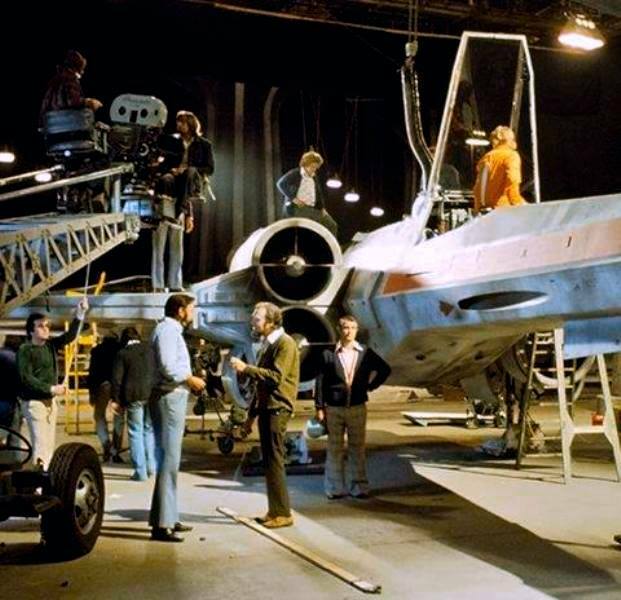
| The full-size X-wing fighter at Shepperton, soon needing to rise into the air! |
 |
| Stears confers with a colleague by the singular fully built X-wing fighter. |
Another large prop, the singular, specially built X-wing fighter, would also need Stears help and service later on that Summer at the huge
Shepperton Studios facility, as the technician organised the use of a huge building crane to lift it into the air as a lead-in to the all-important Battle of Yavin seen at the end of the film.
 |
| The tremendous explosion concocted by Stears for the action-packed opening of STAR WARS! |
Beyond droids and speeders, Stears would further lend his skills to the films many impressive laser battle pyrotechnics and was most noteworthily responsible for the epic blast that launched the Imperial Stormtroopers into the Rebel Blockade Runner at its start-an explosion so big and loud, though mis-timed apparently, spectators recalled it shook and almost demolished the lime green corridor set around them (as well as almost ending Stears life and career indefinitely!), and would be well remembered by the actors and stuntmen playing friend and foe. Just watch the final film and see for yourself how big that on-screen blast actually is: the debris that shoots past the camera and the shock on the Rebel soldiers faces as it goes off. No fear acting required - this was the
real thing! (Only a few months earlier, Stears had also
almost destroyed the
Death Star cell bay elevator entrance too, due to a similar mixture of explosives, though ultimately blaming the set creators for making the set from weak materials!)
 |
| Stears accepts his 1978 Academy Award for STAR WARS, alongside the US effects team headed by John Dykstra (far right). |
For the behind the scenes crew making STAR WARS, and especially George Lucas, problems and delays from the practical special effects became irksome (most notably with the often out of control droids wandering on and off whilst also crashing into things, due to radio control problems), alongside some practical failures that had to have solutions realised in costly post production (like the ultimate disappearance of Ben Kenobi into the Force after his duel with Darth Vader), with Stears taking the brunt, but nonetheless the final on-screen results achieved by all concerned proved worthy of the toil and trouble, of which the UK veteran would join his American counterparts in winning a well-deserved Academy Award for the films ultimately incredible and audience acclaimed effects in 1978. (His only pity, he recalled at the time, being that his entire dedicated crew working at Elstree couldn't equally have been given the awards/recognition they deserved.) Stears would later be disappointed that American effects supervisor Dykstra would claim sole credit for the onscreen realisation of the lightsaber for the original movie (the US rotoscope animation work having enhanced the UK shot blade work in post production).
 |
| John Stears' special trade paper 'Thank You' to his UK crew and team mates who had worked on the original Star Wars' practical effects. |
The next big-league project on the cards for Stears in 1978 was to have been the sci-fi horror classic,
Alien. Enjoying the early script and personally finding it superior to
Star Wars, he was excited at working on the film's model and practical studio work, yet the project ultimately went to his UK rival Brian Johnson (with Nick Allder), presumably due to internal politics at the studio/ behind the scenes, or due to director Ridley Scott, a tough man to work with, wanting to pick his own team/s.
Despite the loss of
Alien, Stears at least had the next film in
The Adventures of Luke Skywalker-then only known as STAR WARS II- to look forward to. Having believed he had developed a prior good rapport with Lucas (often sharing a car to the studios with the director and exchanging many conversations) Stears was hoping to be ready for more pre-production time for II to do an even bigger and better job for the first sequel. Surprisingly, there was more personal disappointment to come- the veteran was
not selected as part of the original core team returning to work on the film series, either: the producers instead relying on the aforementioned UK (and US co-partner) practical effects supervision of the now available, and equally talented, Brian Johnson. (Perhaps Johnson was seen as someone whom Lucas/Kurtz may have felt was a younger and more hip kinsman to them, rather than Stears, who, post his duties on the original Star Wars, could have been seen as being too 'old school', perhaps too much of the elitist guard of homegrown British filmmakers who had caused so much behind the scenes ire to Lucas/Kurtz back in 1976?).
Despite some mild and brief behind the scenes friction between Stears and Johnson linked to the 1979 upcoming production of the new film (soon titled THE EMPIRE STRIKES BACK), regarding the remote controlled Artoo design and re-development/improvements, the former, with his further Oscar clout from the original
Star Wars under his belt, eventually made his way States-side to resume a continued, noteworthy effects career (including working on such cults hits as THE MARTIAN CHRONICLES (as Second Unit Director and Effects Supervisor for the lengthy three-part mini-series filmed on location likely around the same time as EMPIRE was in production) and Sean Connery's
HIGH NOON
in space, OUTLAND). Later into the early nineties he worked on another big league sci-fi saga, the pilot episode of the BABYLON 5 TV series:
The Gathering, before his sad passing at the young age of 64 in 1999.
 |
| John Stears: 1934 - 1999 |
His contributions to the original saga continuing to resonate with audiences of all ages in this 35th Anniversary of the original STAR WARS, the name, work and legacy of
John Stears lives on within the magic of movies...
For more detailed information on John Stears work on the original STAR WARS, check out the AFICIONADO special issue dedicated to THE MAKING OF STAR WARS: A NEW HOPE, here:
STAR WARS AFICIONADO MAGAZINE SPECIAL: THE MAKING OF STAR WARS (1977)
With thanks to Chris Baker for selected stills.
Rare John Stears behind the scenes feature from 1977: