, Princess Leia Organa and the other Rebel leaders at their Yavin IV base initiate a memorable medal ceremony for Luke Skywalker and Han Solo (also accompanied by Chewbacca), watched and cheered on by assembled soldiers, officers and pilots, as the original
 |
| A modern look at Stage H at Shepperton Studios. Image: The Kurtz/Joiner Archive. |
With Sir Alec Guinness now managing to take a prior arranged week's break, the 13th and 14th May, 1976 sees the main cast of younger stars of
Star Wars head from Elstree to the larger spaces of Shepperton Studios Stage H, so as to capture the first of two planned sequences set on the jungle world of Yavin IV (the move also gives the dedicated Elstree set builders time to work on future sets that need to be ready for filming there upon the main crew's return). First off at Shepperton is to be the memorable finale taking place within the huge open Massassi temple celebration interior, in which Han Solo and Luke Skywalker, with Chewie behind them, make their way to a special step raised dias and receive their medals of bravery from the beautiful Princess, watched and clapped on by the rest of the assembled Rebel Alliance (of which, in the original
Ralph McQuarrie production paintings for this scene,
from the early Third and Fourth Draft scripts, a survived
Obi-Wan Kenobi is among the party (and which also sees Threepio walking amongst the band) about to receive their
medals). The filmed scene is, controversially, an almost an exact
recreation of a similar sequence within the Nazi Germany World War II propaganda movie,
Triumph Deus Willens (1934), if used for more positive and fantasy effect.
 |
| British extras gather outside Stage H at Shepperton Studios, presumably during a lunch break. Note the barrow full of greenery likely needed as extra set dressing for the temple interior. |
 |
| A look at the movable set-dressed walls of the temple exterior at Shepperton Studios. Image: Star Wars Archives. |
 |
| George Lucas (bottom far left) watches Assistant Director Anthony Waye observing the extras whilst Jamie Harcourt prepares the filming clapperboard at Shepperton in May 1976. Image: the Ben Ageros Collection. |
 |
| Preparing to film an ultimately unused scene that would likely have required multiple on set extras rearrangements and ongoing camera take exposure trickery. |
The Massassi
throne room set is designed so that all of the filming
coverage can be done without visual effects (bar one
establishing shot showing the entire room) and budget
restrictions mean that only two hundred background
artist extras, instead of thousands, constantly re-arranged to make it look as if there were more Rebels
on screen than there actually were, can be hired (not
needing as many people for additional background shots
the second filming day, that amount is whittled down to
around 150 people). Costume Designer John Mollo and his team, in liaison
with the famous
Bermans and Nathans costumers, create
the vast amount of different Rebel outfits needed for the
sequence (though, due to budget restrictions, many of
the extras playing generic technicians end up wearing their own telltale seventies high-heeled shoes in the filming, rather than any specially made items).
 |
| Gary Kurtz starts taking stills images alongside the camera crew as filming begins of our heroes walkdown. |
 |
| Assembling the extras in specific arrangements on set (note Gary Kurtz handling the crowd layout sheets for filming) as Hamill talks to the extras about the scene and its place in the movie. Image: the Ben Ageros collection. |
 |
| Unused ground level angle of our heroes. |
 |
| The walk down continues. Image: Star Wars Archives. |
 |
| George Lucas and his team capture close-ups of our heroes on their walk to the princess. |
 |
| Galactic heroes! An image, likely taken by Gary Kurtz, used for prime publicity. |
Additionally, John Barry uses cardboard cut outs/ photo
blow ups of the extras to enhance the scene further (two
matte paintings by Harrison Ellenshaw - one of the crowd
and another showing a natural light source above- would
finish the job for a long shot, adding even greater size
and people to the sequence). The use of blow ups is not a
new idea in film making- most television production
designers having used this trick to keep production costs
down, especially with drama shows (British science
fiction television programmes like
Doctor Who used
this technique a lot, especially in the Sixties). In the 1997
Special Edition re-release, this sequence
was changed further- the
cut-out extras of the
original 1976 filming
now replaced with a full
complement of living
human extras.
Already helping out on
the film shooting material
as part of what he would
term a “quasi-second
unit”, Gary Kurtz handles
the filming of certain
shots of the throne room
sequence instead of
Gilbert Taylor. Kurtz would recall to the IGNFF website: “Gil
just said he didn't want to be responsible for the
camera work there
because it was a
complicated series of
mattes, and I said, "Fine,
just do the lighting and I'll worry about the shots." It
wasn't really that complicated – it was just a locked down camera and we moved the extras around on the
floor. All this stuff sounds very archaic now, it all could
be done digitally and no one would think twice about it,
but at that time, what had to happen was the camera had
to be very clearly locked off, and each section of the
extras standing in their line had to be shot piece by piece
in about eight different sections so we'd have a room full
of people when they were all mounted together. Then on
top of that, we did one where all of the extras dressed up
in a variety of costumes stood along the frontline right in
the middle, and did the scene with the actors walking
down the aisle up to the end where the throne was. A
very standard kind of matte shot that has been done on
hundreds of pictures since the 1920s, and as I say now it
looks quite archaic – working that way, because it's so
time consuming – but it worked fine then.”
 |
| Kay Freeborn tends to the Chewbacca costume inhabited by Peter Mayhew. |
 |
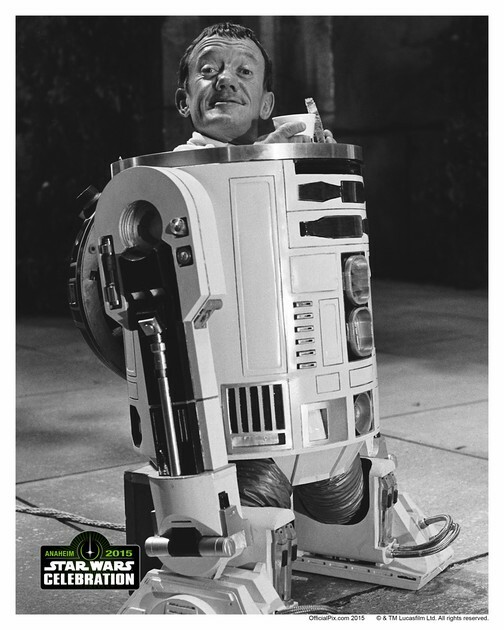
| Kenny Baker enjoys a cup of tea and sandwich on the set. |
 |
| The cleaned-up, fully repaired Artoo joins the thoroughly golden Threepio for the medal ceremony in this classic stills shot. |
During filming of the finale medal scene, the cast joked that if they did a
sequel they hoped it wouldn't start off right from the scene
where the gang are on the Massassi Temple steps after
receiving their medals. Specially posed photographs of
the medal adorned heroes happily celebrating with
Princess Leia never appeared in the film. In an early
draft of the script, Chewbacca did indeed receive a
medal for his bravery against the Empire, yet Lucas
dropped the idea, thinking that the Wookiee race would
have a different set of values regarding the receiving of
awards.
The 30 feet high steps of the
temple Throne Room set, with
walls surrounded by lush
creeper like plants (specially
brought in for the film), would
prove a worry for Kenny Baker
who had a scene requiring his
character to move slightly
forward from Threepio whilst
the little droid reveals his
newly repaired self to his
fellow star warriors.
 |
| A rare out of the suit shot of Anthony Daniels at Shepperton. |
 |
| One of the infamous matchbooks created by Anthony Daniels for the cast and crew of the film. |
Anthony
Daniels, meanwhile, would
enjoy being at the
Shepperton location,
enjoying the area’s nearby
locales and preferring it to the
“morbid high street of
Elstree”. Unfortunately, he would continue to play the part of
Threepio so convincingly that
the crew still forgot that there
was a man inside the suit and
mask, and despite the fact that he would soon only partially wear the uncomfortable golden outfit in its entirety prior to the main filming. Fed up with the
situation, Daniels would have matchbooks printed up
with the word '3PO IS HUMAN!' on the front - which he would
leave on cast and crew buffet tables. “They thanked me
but most of them didn't get my point”, the actor would
hilariously recall in 1999.
 |
| General Dodonna (Alex McCrindle) presents Han Solo's medal to Leia. Image: Kurtz/Joiner Archive. |
Veteran British film and TV actor Alex McCrindle joins the cast as General
Jan Dodonna for the scenes where he presents Princess
Leia the medals to give to Han and Luke (though his voice is later dubbed by an American actor, Peter Hobbs, in post production), whilst extras
would include Clive Bennett, Ted Western (one of the
rear platform honour guards, as well as being involved in
the film’s prop department), and a very young Derek Lyons, who
plays both a medal bearer and a Massassi temple guard
in the film.
 |
| Filming another angle of the walkdown. Note the temple guards in the background (one of whom was played by Derek Lyons). |
 |
| Filming from an angle towards the Rebel leaders that was not ultimately used in the film. |
Some of the other ground level British background
artists during the Throne Room scene filming would be
arrogant and unfriendly towards the young cast of soon to be major stars, calling Ford and Hamill “wankers”
under their breath as they went up to collect their
medals. Though Hamill, wearing a dyed yellow ski jacket bought in (or possibly previously orange and worn by
Pondo Baba in the Cantina scenes filmed a month earlier at Elstree), was upset by the
rude goading (especially having helped fill in the film's story to the crowd so that they knew what was going on), Ford would shrug it off, telling Hamill: “Hey,
who gives a shit? Forget about it.” In one funny blooper,
Ford, wearing his newly received medal, tests the metal
to see if it’s gold by biting down on it!
 |
| Now able to put on the bulky and painful droid costume only when necessary for actual filming, Anthony Daniels watches Hamill and Fisher camera rehearse their medal scene. |
The striking necklace worn by the newly costumed Princess Leia is titled
"Planetaariset Laaksot" which means "Planetary
Valleys" and was made by Lapponia of Helsinki. It was
the creation of jewellery designer Björn Weckström.
When LUCASFILM/John Mollo purchased the necklace
from his Fulham shop, the designer wasn't told what the
film was about and was surprised to see it worn by
Carrie Fisher in a
movie, which
"later became a
cult". The item was
introduced in
1969 and
produced until
1981.
Stars Wars dress worn by Carrie Fisher as set to sell for up to $2M | Daily Mail Online
 |
| Producer Gary Kurtz confers with Hamill and Ford during a filming break. Image: Kurtz/Joiner Archive. |
Though Leia’s
blaster prop is
most famous for being used by the character later in the
filming schedule
on the Blockade
Runner, it should
also be noted that the weapon was worn first with this sequence, by Luke
Skywalker at the Rebel Ceremony-indeed several posed
promotional pictures of Hamill in Luke’s medal
ceremony costume (pulled together by the costume team
at the last minute as Lucas wanted the character to look
more grown up for the film’s conclusion) would be taken showing him using the weapon (this would be a fact lost on
KENNER with their later 'Power of the Force' toys, as Luke's ceremonial
figures (3 3/4" and 12") instead have him with a Han Solo "Mauser style"
blaster).
Only two medals were specially made in-house for the film, for Luke and Han to be given by Leia. In one famous blooper on the ceremony dais, Harrison Ford checks out the gold lining of his medal by biting into it.
 |
| Ford goofs around during filming. |
 |
| Just good friends? Hamill and Ford lark about on set. Image: Kurtz/Joiner Archive. |
 |
| A thrilled Luke receives his medal from the beautiful Princess Leia. |
Of the final scenes, and the love triangle being
established between Leia, Luke and Han, and just who
would get the girl, Carrie Fisher would joke in 1978:
"We all thought about it. I've insisted there is absolutely
no truth to the rumour about me and the Wookiee. I was
partial to Artoo. I was glad he was shorter. But you
know, in the last scene Mark and Harrison sort of go,
'Hey, buddy,' and they cut. So I said I understand now
who gets the guys. They do. And the Wookiee and I sort
of skid off together. Do you think Wookiees believe in
marriage?"  |
| Presumably a rehearsal image for the planning of extras. |
 |
| Approaching the Medal bearer party. |
 |
| Alternate filming take for crowd re-arrangement superimposition. |
 |
| A terrific side angle from atop the Studio as our heroes turn to the Rebel applause. |
On the 14th May, before the medal sequence has finished
filming, and under supervision from the First Assistant Director, Tony Waye, the cast and extras sing
Happy Birthday! to a highly embarrassed George Lucas.
Anthony Daniels, who, that day, would complain of a
sore right hand caused by his costume chaffing, also
recalls Waye giving him an important
piece of advice on an extras-heavy day: "He told me to
have lunch (which was served in a couple of tents on the
studio grounds) a little early. I said I could wait
for everyone else, to which he responded: 'have you ever
seen a crowd of extras rush for lunch?'"
 |
| Lucas on set (with camera operator Ronnie Taylor) wearing a Shepperton Studios jumper likely given to him as an additional birthday gift by the studio. |
Listed on the production notes, on May 14, the filming
period was 8:30 to 5:40. On Tuesday, May 18th, it's 8:30
to 7:35. On Wednesday, it's 8:30 to 5:30. Three of the
four days would
have set-up times
of an hour, an
hour and a half,
and two hours,
fifteen minutes.
With filming
completed, the
sets would be
torn down and construction beginning anew for the film - this time for the Yavin IV hangar bay, for upcoming
filming the upcoming June.
 |
| Our heroes in individual celebration. |
 |
| Receiving a warm ovation from the assembled Rebel crowds. |
With thanks to
Chris Baker for selected images used in this article.
This is the final entry in Star Wars Aficionado's Forty-Fifth Anniversary celebrations of the original 1977 version of Star Wars. We hope you've enjoyed the expansive coverage.